E-Way Bill Validity: How Long Is It Valid, Validity Rules, and How to Extend (Complete Guide 2025-26)
One of the most stressful situations in goods transport is when an e-Way Bill expires before the goods reach their destination. Transporters, suppliers, and recipients across India face this every day especially during long-distance deliveries, monsoon disruptions, highway closures, or vehicle breakdowns. This guide explains exactly how e-Way Bill validity is calculated, when it starts, what the rules are in 2025, how to extend it step by step, and exactly what to do if your EWB expires during transit.
What is E-Way Bill Validity?
E-Way Bill validity is the time period during which an e-Way Bill is legally valid for the movement of goods. Once an EWB is generated and Part B (vehicle details) is filled, a validity clock starts. Goods must reach their destination before this clock runs out. If the goods are still in transit when the EWB expires, the movement becomes legally non-compliant and the vehicle can be detained by GST officers.
The validity period is not fixed it is calculated based on the distance between the dispatch location and the delivery location. The longer the distance, the longer the validity. This ensures that genuine long-distance consignments have enough time to reach their destination.
When Does E-Way Bill Validity Start?
This is one of the most important and most misunderstood points about EWB validity. The validity countdown does NOT start from the time Part A is generated. It starts from the date and time when Part B (vehicle details) is first entered specifically at midnight of that day.
More precisely: the validity expires at midnight of the last day of the validity period, counted from the date of Part B entry.
Example: Part B is filled on Tuesday at 2 PM. If the EWB has a 2-day validity, it expires at midnight on Thursday (end of Thursday). This gives the transporter until the end of Thursday to deliver the goods.
This design is intentional it rewards businesses that plan ahead by allowing them to Generate E-Way Bill Part A in advance (e.g., the previous day) and start the validity only when the vehicle actually loads the goods.
E-Way Bill Validity Rules Complete Table (2025-26)
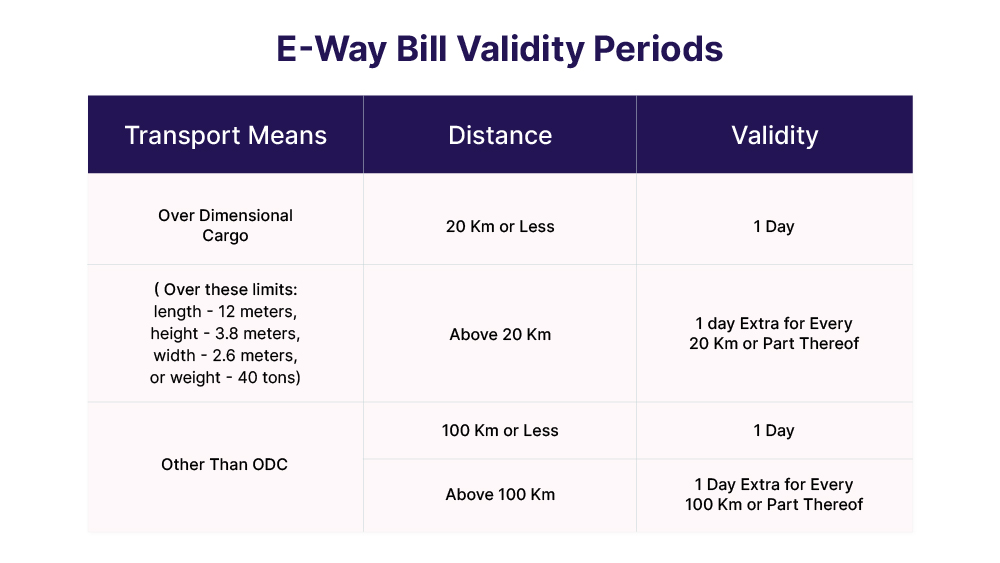
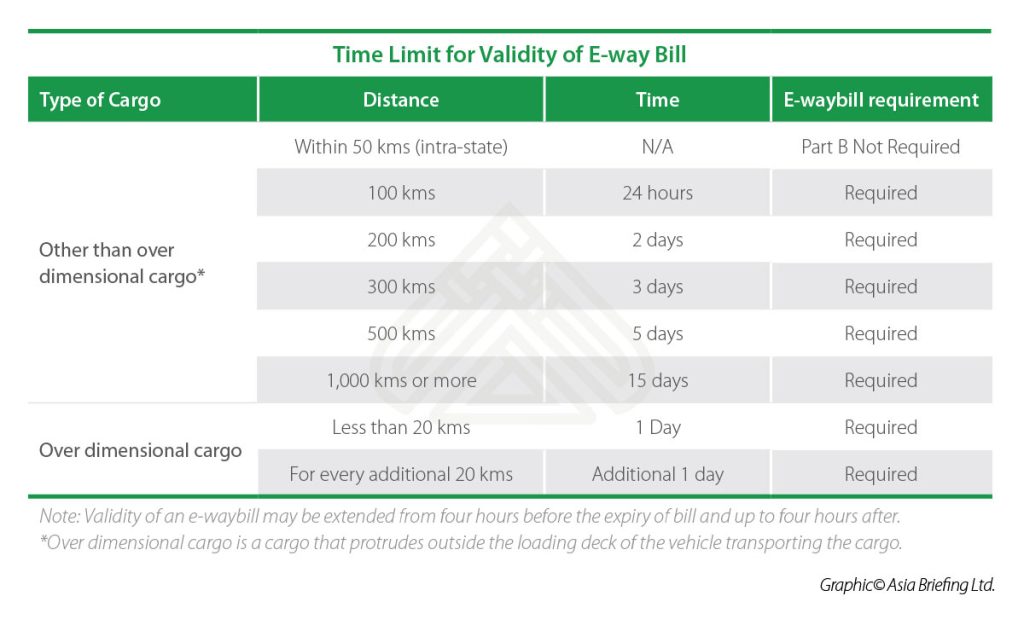
The validity of an EWB depends on two factors: the type of cargo (regular or Over-Dimensional Cargo) and the distance to be covered.
For Regular (Non-ODC) Vehicles
| Distance to be Covered | EWB Validity Period |
| Less than 200 km | 1 Day |
| 200 km to 400 km | 2 Days |
| 400 km to 600 km | 3 Days |
| 600 km to 800 km | 4 Days |
| 800 km to 1000 km | 5 Days |
| For every additional 200 km or part thereof | +1 Additional Day |
For Over-Dimensional Cargo (ODC) Vehicles
| Distance to be Covered | EWB Validity Period |
| Less than 20 km | 1 Day |
| 20 km to 40 km | 2 Days |
| 40 km to 60 km | 3 Days |
| For every additional 20 km or part thereof | +1 Additional Day |
Over-Dimensional Cargo (ODC) refers to goods that exceed the standard permissible dimensions for road transport such as large industrial machinery, structural steel sections, or heavy equipment. ODC vehicles have much stricter validity rules because they travel slower and require special permits.
How to Calculate Validity Worked Examples
| Scenario | Distance | Cargo Type | Validity |
| Mumbai to Pune delivery | 150 km | Regular | 1 Day |
| Delhi to Jaipur delivery | 280 km | Regular | 2 Days |
| Chennai to Hyderabad delivery | 630 km | Regular | 4 Days |
| Mumbai to Kolkata delivery | 2000 km | Regular | 10 Days (1 day per 200 km) |
| Factory to nearby plant | 18 km | ODC machinery | 1 Day |
| City to port for export | 45 km | ODC steel structure | 3 Days |
The 360-Day Maximum Validity Cap New Rule from January 2025
From January 1, 2025, a new rule introduced a hard cap on e-Way Bill validity: the total validity period of any EWB including the original validity period plus all extensions cannot exceed 360 days from the date the EWB was originally generated.
This rule was introduced to prevent the misuse of EWBs where businesses would generate an EWB and keep extending it indefinitely to cover fraudulent or backdated transactions. The 360-day cap ensures every EWB has a finite life.
In practice, no genuine commercial consignment takes more than 360 days to deliver. If you find yourself needing more than 360 days on a single EWB, that is a sign something unusual is happening contact your CA or the helpdesk.
How to Check the Validity of Your E-Way Bill
There are two easy ways to check the current validity of an EWB:
Method 1: Without Login (Public Search)
- Go to https://ewaybillgst.gov.in
- Click Search in the top navigation.
- Click e-Way Bill search.
- Enter the 12-digit EWB Number.
- Click Go. The result shows the Valid Until date and time.
Method 2: After Login
- Log in to the portal.
- Go to e-Way Bill > Print EWB.
- Enter the EWB number and click Go.
- The full EWB displays the generation date, Part B entry date, and exact Valid Until timestamp.
Always check validity before dispatching goods for long-distance deliveries. If the calculated validity seems too short for the actual journey (due to expected traffic, weather, or route conditions), enter a slightly higher distance value during generation up to 10% more than the system-suggested distance is allowed.
How to Extend E-Way Bill Validity Step-by-Step
If goods cannot reach their destination within the original validity period, you must extend the EWB before it expires or within 8 hours after it expires. Here is the exact process:
Who Can Extend EWB Validity?
- The person who originally generated the EWB.
- The recipient of the goods.
- The transporter handling the consignment.
Any of these three parties can initiate the extension. In practice, it is usually the transporter or supplier who extends when a delay occurs.
Step-by-Step: Extend EWB Validity
- Log in to https://ewaybillgst.gov.in
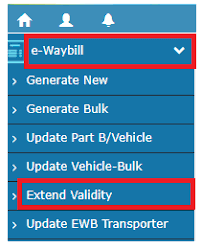
- In the left-side menu, click ‘e-Way Bill’.
- Click ‘Extend Validity’ from the dropdown options.
- Enter the 12-digit EWB Number you want to extend.
- Click Go. The current EWB details will be displayed including the current validity end time.
- In the extension form, select the Reason for Extension from the dropdown:
- Natural Calamity floods, landslides, cyclones affecting the route.
- Law and Order Situation bandh, curfew, road blocks, or strikes.
- Transhipment goods transferred between vehicles or modes of transport.
- Accident vehicle accident causing delay.
- Others any other genuine reason not covered above.
- Enter the current location of the consignment the city or area where the goods currently are.
- Enter the updated estimated distance remaining to the destination.
- The system will calculate the additional days based on the remaining distance.
- Click Submit. The EWB validity is immediately extended.
- Print the updated EWB which now shows the new Valid Until date and time. Give the updated copy to the driver.
After extending, always print and share the updated EWB with the driver. The previous printed copy shows the old expiry time and may confuse GST officers at checkposts who scan the QR code and see a different validity on their screen.
The 8-Hour Extension Window Before and After Expiry
The e-Way Bill system allows extension within a specific time window. If you miss this window, you cannot extend on the portal and will need to generate a completely new EWB.
| Time of Extension Request | Is Extension Allowed? |
| More than 8 hours before expiry | Yes can extend anytime |
| Within 8 hours before expiry | Yes can extend |
| At the exact moment of expiry | Yes can extend |
| Within 8 hours after expiry | Yes extension still allowed |
| More than 8 hours after expiry | No extension not possible. Generate a new EWB. |
Do not wait until the last minute to extend. Always extend at least 2 to 3 hours before expiry so you have time to handle any portal delays, OTP issues, or other technical problems.
What Happens If an E-Way Bill Expires During Transit?
This is the most urgent situation related to EWB validity. If the EWB expires while goods are still on the road:
Immediate Steps for the Transporter
- Stop the vehicle. Do not continue moving goods under an expired EWB.
- Note down the exact current location of the vehicle and the EWB number.
- Call the supplier or recipient immediately and inform them of the situation.
- Ask them to log in to the portal and extend the EWB validity.
- If you are within the 8-hour post-expiry window, extension is still possible.
- Once the extension is confirmed and the new valid until time is shown, the driver can resume the journey.
- Print the updated EWB if possible, or save a screenshot of the new valid until time on the phone.
If Extension Is Not Possible (Past 8-Hour Window)
- The supplier or recipient must generate a completely new EWB.
- The new EWB must be generated using the same invoice details.
- Part B must be filled with the current vehicle number.
- The transporter must wait at their current location until the new EWB is generated and shared.
- Only once the new EWB is active can goods continue moving.
Generating a new EWB for an ongoing transit (because the old one expired) is a common practice and is not penalised by itself as long as goods are not actually moving during the gap between the expired EWB and the new one. The violation is moving goods without a valid EWB, not the act of generating a second EWB for the same consignment.
Penalties for Carrying Goods with an Expired E-Way Bill
If a GST officer stops a vehicle and finds that the e-Way Bill has expired, the following consequences apply under Section 129 of the CGST Act:
- The goods and the vehicle are detained on the spot.
- A penalty is levied equal to the tax amount applicable on the goods with a minimum of Rs. 10,000 even for small consignments.
- To release the detained goods, the owner must pay the penalty or provide a security deposit.
- If the penalty is not paid within a specified time, the goods can be confiscated by the tax department.
- The detained vehicle cannot move until the penalty is paid and the EWB situation is resolved.
These penalties are serious and completely avoidable. A timely extension costs nothing and takes 2 minutes on the portal. Always monitor EWB validity for long-distance consignments.
Practical Tips to Avoid EWB Validity Issues
- Enter distance correctly at generation time: Do not underestimate the road distance. Always enter the actual road distance between dispatch and delivery PIN codes. Add the full permitted 10% buffer for route variations, traffic, or diversions.
- Fill Part B on the day of actual dispatch: Do not fill Part B days before the vehicle loads. Fill it on dispatch day so the validity clock starts from the actual departure day.
- Set a reminder for long-distance deliveries: For consignments travelling more than 500 km, set a phone reminder 6 hours before the EWB expiry to check the status and extend if needed.
- Keep the portal login accessible on a smartphone: The transporter or supplier must be able to log in and extend validity at any time during transit not just during office hours.
- Use the backup portal: If the primary portal is slow during an urgent extension, immediately switch to https://ewaybill2.gst.gov.in. Same credentials, same data.
- Communicate with the driver: Train drivers to immediately call the office when they encounter any delay that might affect EWB validity traffic jams, road closures, vehicle issues. Early communication gives the office time to extend before expiry.
- Never cancel and regenerate unless absolutely necessary: Cancelling and generating a new EWB for validity reasons is acceptable but adds paperwork. Extending the existing EWB is always simpler.
E-Way Bill Validity for Special Scenarios
Validity for Export Consignments
For goods being exported from India, the EWB must cover the distance from the factory or warehouse to the port or airport. The validity is calculated based on this distance. For export consignments, only the distance within India is counted not the international shipping distance.
Validity for Import Consignments
For imported goods moving from the customs port or airport to the final destination, the EWB validity is calculated from the port to the delivery location. The distance entered should reflect the road distance from the port to the delivery PIN code.
Validity for Job Work Consignments
Job work consignments are treated the same as regular consignments for validity purposes. The validity is based on the distance between the principal manufacturer and the job worker’s premises. If the goods are returned after job work, a separate EWB must be generated for the return journey with its own validity calculation.
Validity for Consolidated E-Way Bills
A Consolidated EWB (CEWB) covering multiple consignments in one vehicle follows the validity of the individual EWBs. The consolidated EWB itself does not have an independent validity the individual EWBs it references must each remain valid for the duration of transit.
E-Way Bill Validity Frequently Asked Questions
When exactly does the EWB validity start?
Validity starts from the date (not the exact time) when Part B is first entered. Specifically, the EWB is valid until midnight of the last day of the validity period, calculated from the Part B entry date. For example, if Part B is filled on June 1 and the EWB has 2-day validity, it expires at midnight on June 3 (end of June 3).
Can I extend an EWB validity more than once?
Yes. You can extend EWB validity multiple times, as long as the total validity period (original + all extensions) does not exceed 360 days from the original generation date. Each extension is processed separately and must have a valid reason selected.
What is the maximum validity an EWB can have?
The maximum is 360 days from the original EWB generation date, including all extensions. This rule was introduced from January 1, 2025. No EWB can remain active beyond 360 days regardless of the number of extensions.
My goods are delayed due to floods can I still extend the EWB?
Yes. Natural Calamity is a valid reason for extension listed in the system. Select it when extending during floods, cyclones, landslides, or any other natural disaster that delays delivery. Document the calamity (news reports, government orders) for your records in case of a future audit.
Can I extend validity for a cancelled EWB?
No. Once an EWB is cancelled, it cannot be extended, modified, or reactivated. A cancelled EWB is permanently invalid. If goods still need to move, generate a fresh EWB.
The portal is showing an error when I try to extend what should I do?
First try the backup portal at https://ewaybill2.gst.gov.in using the same credentials. If both portals are down, document the attempted extension (screenshot the error) and contact the helpdesk at 1800-103-4786 immediately. The helpdesk can log a manual extension request in genuine technical failure cases.
Does the vehicle need to be stopped while extending validity?
Technically yes goods should not be moving under an expired EWB. But in practice, the extension is done digitally by the supplier or recipient from wherever they are. The driver should stop and wait for confirmation that the extension is done before continuing.
What happens to the validity if I update Part B with a new vehicle number?
Updating the vehicle number in Part B does not reset or change the validity period. The validity was set when Part B was first entered. Subsequent Part B updates (vehicle changes) only update the vehicle number on record the expiry time remains unchanged.
Can I extend the EWB validity after the goods are delivered?
Technically you can extend a valid EWB even after delivery but there is no reason to do so. Once goods are delivered, the EWB is effectively fulfilled. Extending after delivery serves no practical purpose and could raise compliance questions during an audit.
Is there a fee for extending EWB validity?
No. Extending EWB validity on the official government portal is completely free. There is no charge for extensions regardless of how many times you extend or how many days you add.
About This Guide
This validity and extension guide is published by ewaybill.org for GST taxpayers, transporters, logistics teams, and compliance professionals across India. All rules and calculations in this guide are based on official GSTN advisories and CGST Rules 2017 as updated through June 2026.
- Last Updated: June 2026
- Key Rules Referenced: CGST Rule 138 | GSTN Advisory dated December 17, 2024 (360-day cap) | GSTN Advisory dated June 16, 2025 (Portal 2.0)
- Helpdesk: 1800-103-4786 | Monday to Saturday, 9 AM to 6 PM